The History and Meaning of Juneteenth in Pensacola
June 19, 1865 marked the end of slavery in Texas — but Juneteenth's roots in Pensacola run deep, shaped by the city's unique history as a port city, a military town, and a community that has always known how to hold its own story.
Juneteenth marks the day freedom could no longer be withheld — a meaning that runs deep in Pensacola's history.
<p>On June 19, 1865, Union soldiers arrived in Galveston, Texas and announced that the Civil War was over and that enslaved people were free. The Emancipation Proclamation had been in effect for more than two years. The war had ended in April. But in the far reaches of the Confederacy — Texas, the Gulf Coast, the places where slaveholders had fled with their enslaved people to outrun Union lines — the news had not yet come. Juneteenth marks that arrival: the moment freedom was no longer theoretical.</p>
<p>That date, and what it means, resonates differently in Pensacola than it does in most American cities. Pensacola has a longer, stranger, more contested relationship with freedom and enslavement than its size would suggest. Understanding Juneteenth here means understanding the city first.</p>
<h2>Pensacola and the Long History of Slavery on the Gulf Coast</h2>
Stay connected to Pensacola’s Black community
Be the first to know when new stories drop. Free to subscribe. Unsubscribe anytime.
<p>Pensacola is the oldest European-settled city in what is now the United States. Spanish colonists established a presence here in 1559 — more than sixty years before the Pilgrims landed at Plymouth Rock. The city changed hands between Spain, France, England, and eventually the United States multiple times before becoming part of American Florida in 1821. Through all of those transitions, the institution of slavery persisted and evolved.</p>
<p>The enslaved people brought to the Gulf Coast came primarily through the domestic slave trade after the international trade was formally banned in 1808, though illegal smuggling continued. They labored on the docks of Pensacola Bay, in the naval stores industry that turned longleaf pine forests into turpentine and pitch, in the households of Spanish and American merchants, and in the brick-making operations that supplied the region's construction boom. Pensacola's economy was built, in large part, on their labor.</p>
<p>The city's position as a naval port gave it a particular character. Enslaved people in Pensacola were frequently hired out — rented by their enslavers to work for wages in the shipyard, the timber industry, or domestic service — creating a population that had more geographic mobility and economic experience than enslaved people on rural plantations, but no legal freedom. The money they earned went to their enslavers. The knowledge they accumulated remained their own.</p>
<h2>The Civil War Comes to Northwest Florida</h2>
<p>When Florida seceded from the Union on January 10, 1861, Pensacola became immediately significant. The city had one of the finest natural harbors on the Gulf of Mexico, and the Confederate and Union armies both wanted it. Fort Pickens, on the western tip of Santa Rosa Island at the mouth of Pensacola Bay, remained in Union hands throughout the war — one of only two Southern forts never taken by Confederate forces. The standoff at Fort Pickens in the spring of 1861 was one of the earliest flashpoints of the war.</p>
<p>By the fall of 1861, Confederate forces had evacuated the city of Pensacola and burned what they could not take. The city changed hands effectively, and Union forces occupied Pensacola for much of the remainder of the war. For the enslaved people who had been held in the city and surrounding Escambia County, the Union presence created new possibilities and new dangers simultaneously.</p>
<p>Some enslaved people escaped to Fort Pickens and Union lines during the occupation. The Army's treatment of these "contrabands of war" — as escaped enslaved people were called under the policy established by General Benjamin Butler — was inconsistent and often unjust, but it represented the first practical rupture in the system of enslavement for hundreds of people in Northwest Florida. They worked for the Union Army, gathered intelligence, and began the long process of building lives outside of captivity.</p>
<h2>What June 19, 1865 Actually Meant</h2>
<p>The Emancipation Proclamation, issued by President Lincoln on January 1, 1863, declared enslaved people in Confederate states to be legally free. But a proclamation without enforcement is a document, not a reality. In areas under Confederate control — which included most of the Deep South and the Texas Gulf Coast — enslavers simply continued as before. The news did not travel. Some enslavers actively suppressed it.</p>
<p>When General Gordon Granger arrived in Galveston on June 19, 1865 and read General Order No. 3 — "The people of Texas are informed that, in accordance with a proclamation from the Executive of the United States, all slaves are free" — it was not the legal beginning of freedom. It was the enforcement of freedom that had already been legally established. The distinction matters: Juneteenth is not the day freedom was granted. It is the day it could no longer be withheld.</p>
<p>In Pensacola, the timeline was somewhat different. The city's occupation by Union forces during the war meant that some of the city's Black residents had already been living in a contested freedom for years. But the formal end of the war, Lincoln's assassination in April 1865, and the arrival of Freedmen's Bureau officers in the months that followed created the legal framework — however imperfect — within which the formerly enslaved people of Northwest Florida would begin to build their lives.</p>
<h2>Reconstruction and the Building of Black Pensacola</h2>
<p>The years immediately following emancipation were, in Pensacola as everywhere in the South, a period of extraordinary creativity and extraordinary violence. Freed people built institutions at a pace that still astonishes: schools, churches, mutual aid societies, newspapers, and political organizations rose from almost nothing in the span of a few years.</p>
<p>Pensacola's Black community established churches that became the anchors of neighborhood life — congregations like St. Michael Creole Benevolent Association (founded 1874), which served the city's Creole Catholic community, and the African Methodist Episcopal and Baptist churches that spread through the historically Black neighborhoods north and west of downtown. These churches were not merely places of worship. They were schools, courthouses, banks, and community centers in a city that had provided none of those services to Black residents.</p>
<p>The Belmont-DeVilliers neighborhood — the heart of Black Pensacola for a century — began to take shape during Reconstruction and the decades that followed. Black-owned businesses, professional offices, social clubs, and eventually entertainment venues clustered in this corridor, creating the economic and cultural infrastructure of a self-sustaining community. The Chitlin' Circuit venues that would make Belmont-DeVilliers famous in the mid-twentieth century grew from roots planted in the Reconstruction era.</p>
<p>Black Pensacolans also exercised political power during Reconstruction in ways that would not be repeated for nearly a century. African American men voted, ran for office, and served in local and state government during the years when federal enforcement made that possible. The rollback of Reconstruction — the violence, disenfranchisement, and legal terror of the Jim Crow era that followed — would not erase the memory of what had been built or what had been possible.</p>
<h2>Juneteenth as Living Memory</h2>
<p>For Black Pensacolans, Juneteenth has never been merely a historical date. It has been a living practice — a way of marking time, connecting generations, and insisting that freedom is both a fact and an ongoing project.</p>
<p>The celebration of Juneteenth in communities across the Gulf Coast followed patterns established in Texas and carried by the movement of Black families through the South and into the North. Families gathered. Food was prepared — red foods in particular: red velvet cake, red punch, strawberry soda, watermelon — because red was a color associated with resilience and with West African cultural traditions that had survived the Middle Passage. Music, prayer, and the reading of the Emancipation Proclamation were common elements of early celebrations.</p>
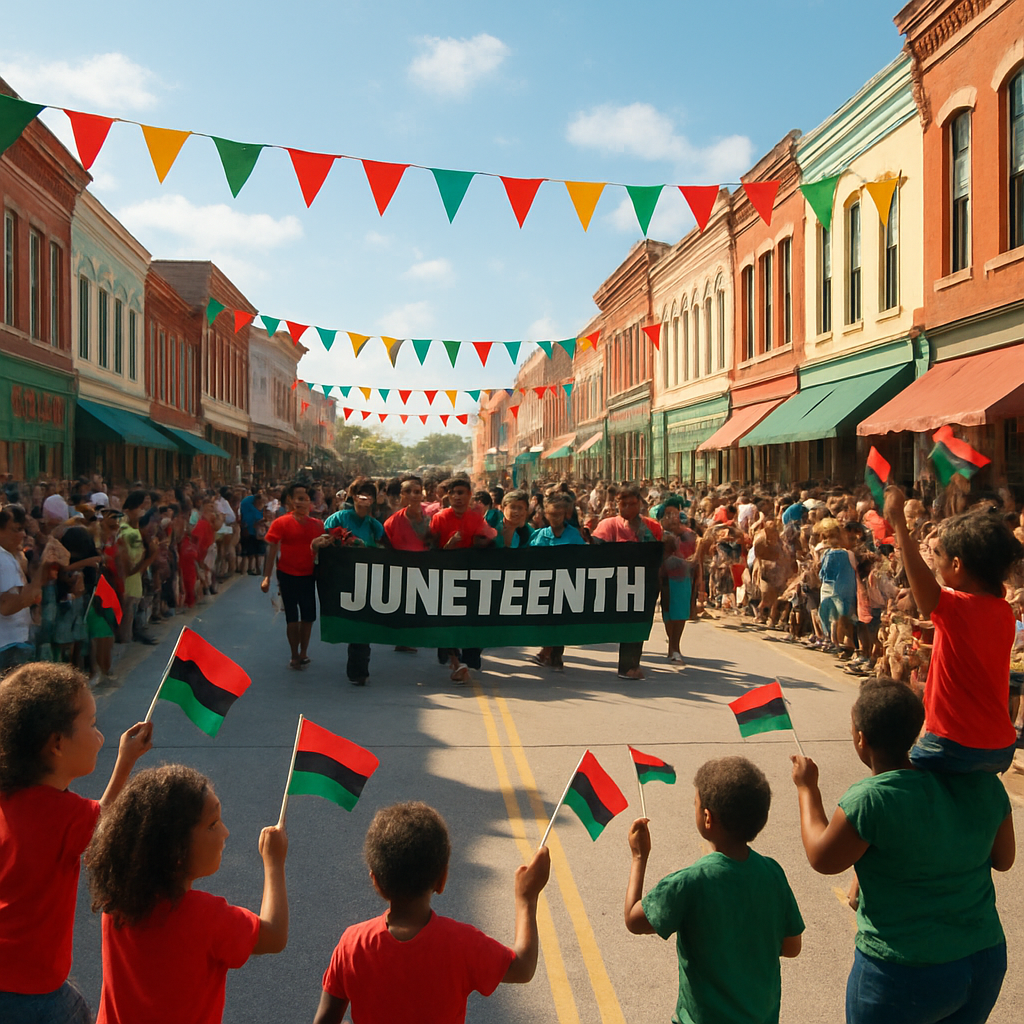
<p>In Pensacola, Juneteenth celebrations have grown substantially in recent decades. The Watson Family Foundation's annual Juneteenth festival — "A Family Reunion for the Culture" — now draws thousands of attendees to Museum Plaza and represents the most visible expression of community celebration in the city's calendar. Gallery Night Pensacola's Juneteenth edition, branded as "Art of Freedom," centers Black artistic expression along Palafox Place. Pensacola State College's annual celebration brings historical programming to the campus community. These are not new traditions. They are the continuation of something very old.</p>
<h2>Why June 19 Was Made a Federal Holiday</h2>
<p>On June 17, 2021, President Biden signed legislation making Juneteenth National Independence Day a federal public holiday — the first new federal holiday since Martin Luther King Jr. Day was established in 1983. The vote in Congress was nearly unanimous: 415-14 in the House, 98-0 in the Senate.</p>
<p>The recognition came after decades of advocacy, largely by Black Americans who had been celebrating Juneteenth for generations while the broader country ignored it. Texas had made Juneteenth a state holiday in 1980, and by 2021, 47 states had some form of official recognition. The federal designation was overdue by a century and a half.</p>
<p>The holiday's national recognition has changed the conversation about what Juneteenth means and who it belongs to. Some Black Americans have welcomed the broader awareness; others have raised concerns about commercialization and appropriation — the tendency to convert a community's hard-won celebration into a marketing moment for companies that would not have recognized the date five years ago.</p>
<p>In Pensacola, as in most places where Black communities have celebrated Juneteenth for generations, the answer to commercialization is community ownership. The Watson Family Foundation festival is organized by and for the Black community. The African American Heritage Society's programming is rooted in institutional knowledge built over decades. The relationships between organizers, performers, and attendees are real relationships — not manufactured for a news cycle.</p>
<h2>The Meaning That Remains</h2>
<p>Juneteenth is not a celebration that freedom has been fully achieved. It is a celebration that it cannot be taken back — that the legal fact of emancipation, however long it took to arrive and however imperfectly it has been honored since, is now part of the foundation of American law and American life.</p>
<p>It is also a celebration of what Black people built in the aftermath of that freedom: the institutions, the culture, the community, the art, the music, and the knowledge that transformed slavery's survivors into the architects of one of the most creative and resilient communities in American history.</p>
<p>In Pensacola, you can trace that arc from Fort Pickens to Belmont-DeVilliers to the Watson Family Foundation festival, from the Reconstruction-era churches to the African American Heritage Society at 200 Church Street. The history is not in a museum. It is in the streets, the neighborhoods, and the people who gather every June 19 to mark what happened and what was built in its wake.</p>
<p>That is what Juneteenth means here. That is what it has always meant.</p>
Get stories like this in your inbox every week
The Pensacola Beacon covers Black culture, history, and community on the Gulf Coast.